Deployment and edge course review — 2026-10-14
Coverage: all 55 course entries (Guide.md / README.md) in Phase 4 Tracks A/B/C and Phase 5 Track C were inventoried and reviewed at entry/topic level. Each now has a distinct integration exercise or a rebuilt connected syllabus. 22 primary source pages were consulted for the technical corrections below.
Depth and limits: This is a targeted technical and pedagogical review, not a claim to have executed or line-by-line certified tens of thousands of lines of existing hardware examples. The depth column distinguishes structural/handoff review from examined technical sections and the fully rebuilt DLA/Gemma courses. Associated Qwen lectures 02–05 received targeted identity/shape and evidence-scope edits; their remaining runtime commands and numerical examples are not fully validated. Existing long Jetson references retain release-specific and illustrative material, explicitly scoped where examined. No Jetson, FPGA, CUDA kernel, radio, or robot performance measurements were run in this review.
Visual: Memory ownership PNG and editable SVG are original curriculum artwork, visually inspected after export. They are embedded in memory, VLA deployment, inference-track, and edge-track guides; no web image was copied.
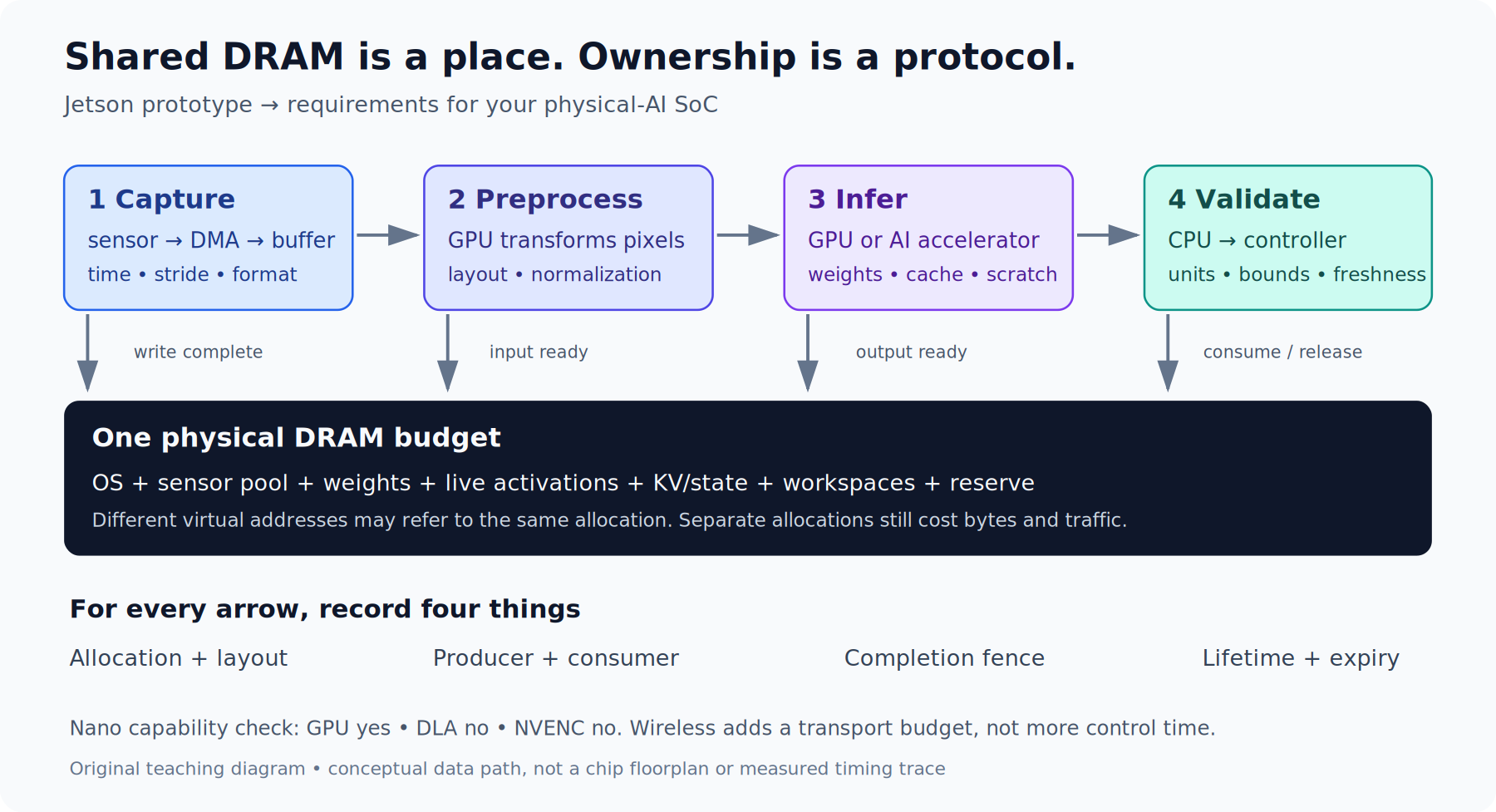
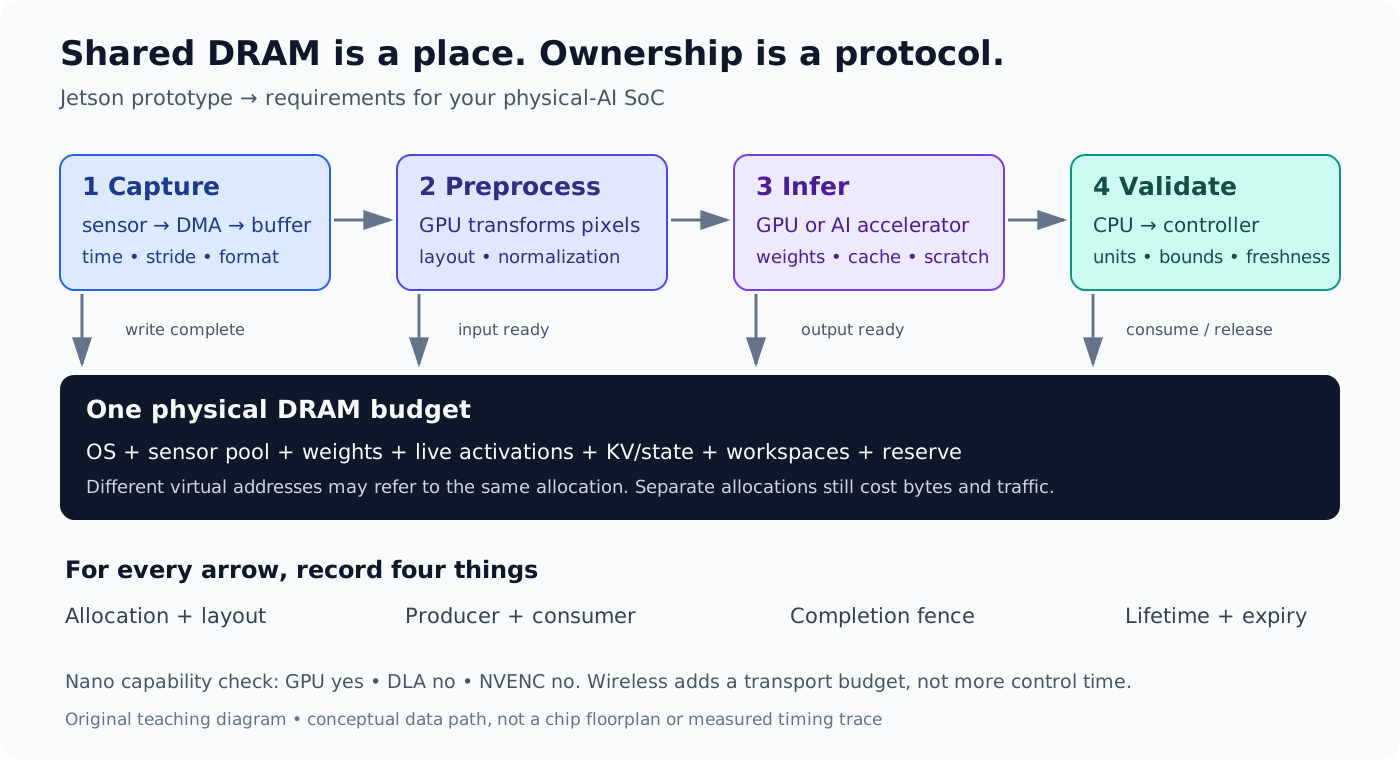
| Course entry | Reviewed depth | Issue / improvement | Evidence handed onward | Sources |
|---|---|---|---|---|
| Phase 4 - Track A - Xilinx FPGA/1. Xilinx FPGA Development/Guide.md | Entry structure and integration exercise | Replaced generic practice appendix with a topic-specific failure case, acceptance evidence, and next-course dependency. | Count accepted inputs and outputs separately; no duplicated or missing result is allowed after excluding explicitly cancelled work. Submit a waveform, timing report, and register/stream interface sketch. | Existing course content; original exercise design |
| Phase 4 - Track A - Xilinx FPGA/2. Zynq UltraScale+ MPSoC/Guide.md | Entry structure and integration exercise | Replaced generic practice appendix with a topic-specific failure case, acceptance evidence, and next-course dependency. | Verify every result and test an invalid length before enabling long runs. Show ownership at submit/completion and account for cache maintenance on the selected coherent or noncoherent port. | Existing course content; original exercise design |
| Phase 4 - Track A - Xilinx FPGA/3. Advanced FPGA Design/Guide.md | Entry structure and integration exercise | Replaced generic practice appendix with a topic-specific failure case, acceptance evidence, and next-course dependency. | Explain each remaining CDC finding and show no loss, duplication, or reordering for the checked traces. A two-flop synchronizer on a multi-bit payload is not an acceptable bus-transfer design. | Existing course content; original exercise design |
| Phase 4 - Track A - Xilinx FPGA/4. High-Level Synthesis (HLS)/Guide.md | Entry structure and integration exercise | Replaced generic practice appendix with a topic-specific failure case, acceptance evidence, and next-course dependency. | Report C/RTL parity and achieved implementation timing. Explain one non-improving variant from the memory/dependency report, then pass the chosen interface and buffer alignment to the runtime course. | Existing course content; original exercise design |
| Phase 4 - Track A - Xilinx FPGA/5. Runtime and Driver Development/Guide.md | Entry structure and integration exercise | Replaced generic practice appendix with a topic-specific failure case, acceptance evidence, and next-course dependency. | No timed-out request may later be reported as a different request. Submit queue-state traces and a userspace ABI test alongside the accelerator register map. | Existing course content; original exercise design |
| Phase 4 - Track B - Nvidia Jetson/1. Nvidia Jetson Platform/Guide.md | Hardware/API sections | Corrected absent DLA, USB/display/camera connectors, historical power-table scope; marked legacy TensorRT APIs. | Produce a capability manifest with Nano DLA and NVENC marked absent, a boot log, and one validated result. Hardware setup is complete only when a peer can identify the same target from the manifest. | S1, S2, S5 |
| Phase 4 - Track B - Nvidia Jetson/1. Nvidia Jetson Platform/Orin-Nano-CUDA-Programming/Guide.md | CUDA/memory claims | Corrected shared-DRAM versus copies/cache behavior, absent DLA, allocation guidance and API scope. | All variants must match a tolerance fixed before benchmarking. Preserve device properties and a timeline explaining which memory access pattern wins; do not infer bandwidth from GPU utilization alone. | S1, S4, S5 |
| Phase 4 - Track B - Nvidia Jetson/1. Nvidia Jetson Platform/Orin-Nano-Camera-ISP-Sensor-Bringup/Guide.md | Camera/DLA boundary | Separated Nano GPU path from optional NX/AGX DLA and added capture-age handoff. | Count frame gaps and measure age distributions with the timestamp clock domain identified. A higher FPS is not a pass if the robot consumes older frames; pass calibration and format metadata to the VLA pipeline. | S1, S5 |
| Phase 4 - Track B - Nvidia Jetson/1. Nvidia Jetson Platform/Orin-Nano-Container-Fleet/Guide.md | Container guarantees | Removed claims that containers guarantee identical host behavior or transactional external state. | A successful process start is insufficient. Submit a known-input inference health check, bounded restart behavior, and a rollback that restores both application and compatible model state. | Existing host/runtime sections; integration reasoning |
| Phase 4 - Track B - Nvidia Jetson/1. Nvidia Jetson Platform/Orin-Nano-DLA-Deep-Dive/Guide.md | Rebuilt course | Replaced nonexistent Nano DLA specifications and fabricated timings with capability, placement, and optional NX/AGX labs. | Capability manifest, strict/mixed placement, output parity, transition costs, and unavailable-hardware rejection. | S1, S6, S19 |
| Phase 4 - Track B - Nvidia Jetson/1. Nvidia Jetson Platform/Orin-Nano-GPIO-SPI-I2C-CAN/Guide.md | GPIO/PWM/display claims | Corrected Jetson.GPIO hardware-only PWM and nonexistent DSI connector; added bus timing evidence. | Report lost samples, bus errors, and command age. For PWM, prove the hardware pin route and frequency; do not treat a Python sleep loop as a motor timing guarantee. | S2, S7 |
| Phase 4 - Track B - Nvidia Jetson/1. Nvidia Jetson Platform/Orin-Nano-Kernel-Internals/Guide.md | Scheduling/API scope | Removed unconditional SCHED_DEADLINE timing claim; added driver lifetime/timeout handoff. | A remove/reprobe cycle must not retain stale ownership or access freed buffers. Submit a call graph, matching BSP/kernel build ID, and logs for normal completion and timeout. | S5, S8 |
| Phase 4 - Track B - Nvidia Jetson/1. Nvidia Jetson Platform/Orin-Nano-Memory-Architecture/Guide.md | Memory/roofline sections | Removed absent engines, corrected I/O coherency, DLA capacity claim, mixed-unit roofline and 1000× ridge-point error. | Provide a memory ledger including model, cache, workspace, camera pool, OS, and headroom. Demonstrate that the consumer waits for completion and that reclaiming a buffer early is caught. | S1, S4 |
| Phase 4 - Track B - Nvidia Jetson/1. Nvidia Jetson Platform/Orin-Nano-OTA-Deep-Dive/Guide.md | Entry structure and integration exercise | Replaced generic practice appendix with a topic-specific failure case, acceptance evidence, and next-course dependency. | Demonstrate one interrupted-install recovery and one failed-health-check rollback. Hashes, active slot, attempt count, and application compatibility must identify the recovered version. | Existing course content; original exercise design |
| Phase 4 - Track B - Nvidia Jetson/1. Nvidia Jetson Platform/Orin-Nano-Power-Thermal/Guide.md | Power/DLA sections | Removed invented Nano DLA power comparison, corrected absent engine table and energy metric. | Use completed requests in energy calculations: joules per request equals integrated energy divided by completions over the same interval. Explain throttling and publish sustained results, not only a cold burst. | S1 |
| Phase 4 - Track B - Nvidia Jetson/1. Nvidia Jetson Platform/Orin-Nano-RT-Linux-Deep-Dive/Guide.md | Deadline guarantee claims | Qualified EDF assumptions and separated CPU reservation from GPU/end-to-end timing. | Publish CPU reservation assumptions and missed-deadline counts for the whole path. Passing cyclictest alone cannot certify a VLA loop; give the controller a timeout and stale-data policy. | S8 |
| Phase 4 - Track B - Nvidia Jetson/1. Nvidia Jetson Platform/Orin-Nano-Real-Time-Inference/Guide.md | Timing/DLA/API sections | Reclassified DLA examples as NX/AGX-only and illustrative numbers; added deadline/age evidence. | Report p50/p95/p99, maximum observed latency, deadline misses, and sample count. Percentiles do not prove a worst-case bound; hand off a measured latency envelope and timeout behavior. | S1, S5, S8 |
| Phase 4 - Track B - Nvidia Jetson/1. Nvidia Jetson Platform/Orin-Nano-Rootfs-and-AB-Redundancy/Guide.md | Entry structure and integration exercise | Replaced generic practice appendix with a topic-specific failure case, acceptance evidence, and next-course dependency. | Identify which component commits success and which reverts the slot. A booting kernel with a broken inference service must fail the application health gate. | Existing course content; original exercise design |
| Phase 4 - Track B - Nvidia Jetson/1. Nvidia Jetson Platform/Orin-Nano-Security/Guide.md | Secure-storage scope | Removed nonexistent Nano eMMC/RPMB assumption; added trust-chain/provisioning exercise. | Submit a trust-chain diagram and key-recovery/rotation plan. Secure boot alone does not encrypt weights or authenticate every downloaded model; specify those paths explicitly. | S2 |
| Phase 4 - Track B - Nvidia Jetson/1. Nvidia Jetson Platform/Orin-Nano-Tensor/Guide.md | Tensor-core topology | Corrected absent Nano DLA and per-SM tensor resource description. | Separate sparse advertised TOPS from dense measured work. Submit error and time at equal shapes plus evidence that the intended matrix path ran. | S1 |
| Phase 4 - Track B - Nvidia Jetson/1. Nvidia Jetson Platform/Orin-Nano-Video-Codec-DeepStream/Guide.md | Codec hardware scope | Added executable software-encode baseline; marked all hardware-encode chapters as optional NX/AGX comparisons. | The Nano baseline must run without NVENC. Treat any hardware-encode pipeline as an NX/AGX comparison and export the measured CPU/DRAM budget to the robot system design. | S3 |
| Phase 4 - Track B - Nvidia Jetson/1. Nvidia Jetson Platform/Orin-Nano-Yocto-BSP-Production/Guide.md | Reproducibility claim | Qualified bit-identical build claim and added exact image provenance handoff. | Boot and validate one sensor/model path on the exact image. Record licenses/SBOM, build provenance, and a recovery image; a successful BitBake exit is only the first gate. | Existing BSP/build sections; integration reasoning |
| Phase 4 - Track B - Nvidia Jetson/2. Custom Carrier Board Design and Bring-Up/Guide.md | Entry structure and integration exercise | Replaced generic practice appendix with a topic-specific failure case, acceptance evidence, and next-course dependency. | Submit rail sequencing and link-validation evidence with a schematic-to-device-tree map. The accepted artifact identifies bottlenecks and recovery access before BSP customization begins. | Existing course content; original exercise design |
| Phase 4 - Track B - Nvidia Jetson/3. L4T Customization/Guide.md | Entry structure and integration exercise | Replaced generic practice appendix with a topic-specific failure case, acceptance evidence, and next-course dependency. | Show the running configuration, not only an edited source file. Pass a manifest with BSP, kernel, DTB, rootfs, and carrier revision to firmware/application integration. | Existing course content; original exercise design |
| Phase 4 - Track B - Nvidia Jetson/4. FSP (Firmware Support Package) Customization/Guide.md | Entry structure and integration exercise | Replaced generic practice appendix with a topic-specific failure case, acceptance evidence, and next-course dependency. | Prove an echoed message and controlled missing-response behavior. Record the original firmware and recovery procedure; carry the message schema and timing contract into application development. | Existing course content; original exercise design |
| Phase 4 - Track B - Nvidia Jetson/5. Application Development/1. Peripheral Access/Guide.md | Entry structure and integration exercise | Replaced generic practice appendix with a topic-specific failure case, acceptance evidence, and next-course dependency. | Invalid data must remain invalid through the caller; no silent substitution with the previous sample. Submit bus-to-application timing and a stable device-identification rule. | Existing course content; original exercise design |
| Phase 4 - Track B - Nvidia Jetson/5. Application Development/2. Network and Connectivity/Guide.md | Entry structure and integration exercise | Replaced generic practice appendix with a topic-specific failure case, acceptance evidence, and next-course dependency. | During an intentional disconnect, stale remote commands expire and local timeout behavior remains observable. Pass a bandwidth/latency envelope and transport framing to the SoC wireless interface design. | Existing course content; original exercise design |
| Phase 4 - Track B - Nvidia Jetson/5. Application Development/3. GUI/Guide.md | Entry structure and integration exercise | Replaced generic practice appendix with a topic-specific failure case, acceptance evidence, and next-course dependency. | Show dropped UI updates instead of growing memory indefinitely. Submit a trace comparing headless and displayed operation and verify that a disconnected sensor is visibly invalid. | Existing course content; original exercise design |
| Phase 4 - Track B - Nvidia Jetson/5. Application Development/4. Multimedia/ESP32-LyraT-I2S-Mic-Jetson-Orin-Nano/Guide.md | Entry structure and integration exercise | Replaced generic practice appendix with a topic-specific failure case, acceptance evidence, and next-course dependency. | Recover the expected frequency and channel order without clipping or persistent sample slips. Save a short WAV and its transport settings for the speech/inference consumer. | Existing course content; original exercise design |
| Phase 4 - Track B - Nvidia Jetson/5. Application Development/4. Multimedia/Guide.md | Nano multimedia scope | Corrected NVENC assumption and added software-encode baseline. | Submit format/stride/sample-rate metadata and latency per stage. Demonstrate one unsupported-format failure and keep its error distinguishable from a model error. | S3 |
| Phase 4 - Track B - Nvidia Jetson/5. Application Development/4. Multimedia/Jetson-Audio-Setup-and-Development/Guide.md | Entry structure and integration exercise | Replaced generic practice appendix with a topic-specific failure case, acceptance evidence, and next-course dependency. | Compare duration/frequency against the reference and count XRUNs under load. Pass a WAV plus preprocessing contract; an intelligible recording alone does not validate timing. | Existing course content; original exercise design |
| Phase 4 - Track B - Nvidia Jetson/5. Application Development/5. ML and AI/Guide.md | DLA/API scope | Separated Nano GPU implementation from optional NX/AGX DLA; flagged legacy TensorRT execution. | Report output/task quality, memory, and capture-to-result latency independently. The optimization passes only when quality and timing budgets both hold; FPS alone is insufficient. | S1, S5 |
| Phase 4 - Track B - Nvidia Jetson/5. Application Development/5. ML and AI/jetson-llm-runtime/Guide.md | Entry structure and integration exercise | Replaced generic practice appendix with a topic-specific failure case, acceptance evidence, and next-course dependency. | Separate prefill, first-token latency, decode inter-token latency, and aggregate throughput. Confirm cancelled work releases ownership and does not contaminate the next response. | Existing course content; original exercise design |
| Phase 4 - Track B - Nvidia Jetson/5. Application Development/5. ML and AI/llm-optimization-jetson/Guide.md | Performance specifications | Removed additive nonexistent DLA TOPS; required dtype-matched decode traffic bound. | Explain where measured performance falls below the memory-traffic bound. Quantized storage is not proof of native low-bit compute, and a sparse INT8 peak is not an FP decode roofline. | S1, S4 |
| Phase 4 - Track B - Nvidia Jetson/5. Application Development/5. ML and AI/non-contact-monitoring-edge/Guide.md | Entry structure and integration exercise | Replaced generic practice appendix with a topic-specific failure case, acceptance evidence, and next-course dependency. | Report false positives/negatives, detection delay, and invalid-input behavior. Do not turn a non-contact research signal into a clinical measurement without the necessary validation. | Existing course content; original exercise design |
| Phase 4 - Track B - Nvidia Jetson/5. Application Development/5. ML and AI/non-contact-monitoring-edge/phase1/README.md | Entry structure and integration exercise | Replaced generic practice appendix with a topic-specific failure case, acceptance evidence, and next-course dependency. | A peer must reproduce the event timeline and identify one intentionally missing interval. Hand the dataset manifest and error cases to later fusion/model work. | Existing course content; original exercise design |
| Phase 4 - Track B - Nvidia Jetson/5. Application Development/5. ML and AI/small-object-detection-jetson/Guide.md | Entry structure and integration exercise | Replaced generic practice appendix with a topic-specific failure case, acceptance evidence, and next-course dependency. | Report recall by object-size bin, false positives, total frame latency, and peak memory. A crop-level accuracy gain passes only if whole-frame deduplication and timing also work. | Existing course content; original exercise design |
| Phase 4 - Track B - Nvidia Jetson/5. Application Development/5. ML and AI/tao-toolkit/Guide.md | Entry structure and integration exercise | Replaced generic practice appendix with a topic-specific failure case, acceptance evidence, and next-course dependency. | Submit export metadata, quantization calibration provenance, held-out quality, and target runtime compatibility. A successful model conversion without output parity does not pass. | Existing course content; original exercise design |
| Phase 4 - Track B - Nvidia Jetson/5. Application Development/5. ML and AI/vla-deploy-jetson/Guide.md | Entry structure and integration exercise | Replaced generic practice appendix with a topic-specific failure case, acceptance evidence, and next-course dependency. | Declare joint/action tolerances and task-success criteria before tuning. Reject stale commands and test sensor dropout; lower kernel time cannot compensate for a broken action contract. | Existing course content; original exercise design |
| Phase 4 - Track B - Nvidia Jetson/5. Application Development/6. ROS2/Guide.md | Entry structure and integration exercise | Replaced generic practice appendix with a topic-specific failure case, acceptance evidence, and next-course dependency. | Bound queue depth and action age. Submit launch/config files plus traces linking sensor sequence to control output, then return the communication and scheduling costs to the inference budget. | Existing course content; original exercise design |
| Phase 4 - Track B - Nvidia Jetson/5. Application Development/Guide.md | Entry structure and integration exercise | Replaced generic practice appendix with a topic-specific failure case, acceptance evidence, and next-course dependency. | Produce an end-to-end trace and show which component drops, expires, or rejects work. Handoff is a runnable integration manifest with defined failure behavior, not six disconnected demos. | Existing course content; original exercise design |
| Phase 4 - Track B - Nvidia Jetson/6. Security and OTA/Guide.md | Entry structure and integration exercise | Replaced generic practice appendix with a topic-specific failure case, acceptance evidence, and next-course dependency. | Record rejection of altered content and a successful compatible rollback. Separate image authenticity, confidentiality, and availability claims in the release dossier. | Existing course content; original exercise design |
| Phase 4 - Track B - Nvidia Jetson/7. Compliance and Manufacturing/Guide.md | Entry structure and integration exercise | Replaced generic practice appendix with a topic-specific failure case, acceptance evidence, and next-course dependency. | Submit a test record format, bounded pass/fail thresholds, and one injected recoverable fault. List applicable compliance work separately from classroom functional tests; they are not certification evidence. | Existing course content; original exercise design |
| Phase 4 - Track B - Nvidia Jetson/8. Runtime and Driver Development/Guide.md | Runtime/hardware sections | Corrected two-DLA-on-Nano and NVENC claims; separated legacy APIs and ownership contract. | A queue-level reference test must catch invalid lengths and stale completion IDs. Pass the command ABI, ownership rules, and unsupported-operation policy into compiler lowering. | S1, S3, S5 |
| Phase 4 - Track C - DL Inference Optimization/01 - Graph and Operator Optimization/Guide.md | Entry structure and integration exercise | Replaced generic practice appendix with a topic-specific failure case, acceptance evidence, and next-course dependency. | Use irregular shapes and a fixed tolerance, report intermediate bytes and kernels removed, and hand the operator shape/dtype contract to kernel engineering. | Existing course content; original exercise design |
| Phase 4 - Track C - DL Inference Optimization/02 - Kernel Engineering/FlashAttention Course/Guide.md | Course map + numerical and IO analysis in lectures 01/02 | Corrected bit-exact/proof claims, materialized attention arithmetic intensity, and confusion between auxiliary memory and total IO complexity. | Declare tolerances rather than promising bit identity. Pass shape/mask coverage and a memory-traffic estimate to the compiler; a fast kernel with the wrong causal alignment fails. | S22; numerical reasoning |
| Phase 4 - Track C - DL Inference Optimization/02 - Kernel Engineering/Guide.md | Entry structure and integration exercise | Replaced generic practice appendix with a topic-specific failure case, acceptance evidence, and next-course dependency. | Submit per-shape error and latency plus resource limits. Keep compile/warmup time outside steady-state timing; pass supported layouts and alignment restrictions to the compiler. | Existing course content; original exercise design |
| Phase 4 - Track C - DL Inference Optimization/03 - Compiler Stack/Guide.md | Compiler scheduling semantics | Separated scheduler fusion from BEAM kernel optimization and required pinned compiler APIs. | Save before/after IR and correctness results. Separate graph fusion from BEAM kernel search, and pass the lowered operator plus memory-layout contract to quantization/runtime work. | S9, S10 |
| Phase 4 - Track C - DL Inference Optimization/04 - Quantization/Guide.md | Entry structure and integration exercise | Replaced generic practice appendix with a topic-specific failure case, acceptance evidence, and next-course dependency. | Compare output and held-out task quality, then identify actual kernel dtypes. Orin does not gain native NVFP4 compute by loading an FP4 file; describe unpack/dequantization work where needed. | Existing course content; original exercise design |
| Phase 4 - Track C - DL Inference Optimization/05 - Inference Runtimes and Deployment/Guide.md | Entry structure and integration exercise | Replaced generic practice appendix with a topic-specific failure case, acceptance evidence, and next-course dependency. | Report request throughput separately from per-request latency and reject overload explicitly. Include cold start, cancellation, and deployment compatibility in the runtime manifest. | Existing course content; original exercise design |
| Phase 4 - Track C - DL Inference Optimization/06 - tinygrad Deep Dive/Guide.md | Compiler scheduling semantics | Corrected BEAM scope and added backend ABI handoff. | Compare shape/layout variants against a reference; preserve the exact source paths from that commit. Pass an unsupported-op policy and launch/buffer ABI to the custom accelerator project. | S9, S10 |
| Phase 4 - Track C - DL Inference Optimization/Guide.md | Track/compiler sections | Corrected BEAM fusion description and integrated memory-ownership visual. | The final bundle contains operator frequencies/shapes, live-memory intervals, measured latency, and a rejected optimization. Use these constraints to size SRAM, DMA, and compute before proposing a chip. | S9, S10 |
| Phase 5 - Advanced Topics and Specialization/Track C - Edge AI/Gemma 4 Edge Deployment/README.md | Rebuilt entry + all six lectures | Corrected release, license, lineup, effective versus stored weights, unbounded global KV, assistant identity; replaced unverified API/throughput claims with connected experiments. | Submit a compatibility matrix with measured versus not-run cells and a memory/latency budget. VLM text output is not itself a calibrated robot action interface. | S11–S14, S18, S20, S21 |
| Phase 5 - Advanced Topics and Specialization/Track C - Edge AI/Guide.md | Entry structure and integration exercise | Replaced generic practice appendix with a topic-specific failure case, acceptance evidence, and next-course dependency. | Submit a resource ledger and Pareto comparison with quality included. Carry the dominant operator, buffer lifetime, and communication bottleneck into the SoC proposal. | Existing course content; original exercise design |
| Phase 5 - Advanced Topics and Specialization/Track C - Edge AI/Qwen Inference Optimization/README.md | Entry + targeted checks across six lectures | Corrected checkpoint identity, FFN size/parameter arithmetic, bias/position settings, cuBLAS guarantees; linked all six lectures and scoped unsourced timing/price figures. | The report must reconcile predicted and stored parameter counts, isolate prefill/decode, and state runtime/quantization support. Pass the bottleneck shape distribution to kernel engineering. | S15–S17 |
Source register
The URLs are source entry points reviewed on the date above; experiments must pin an immutable code/model revision and match BSP/runtime documentation. A failed probe of a guessed TensorRT archive URL was replaced with the verified documentation entry point; it is not counted below.
- S1: NVIDIA Orin power/capability tables
- S2: NVIDIA Nano hardware layout
- S3: NVIDIA Nano software encode
- S4: CUDA for Tegra memory
- S5: TensorRT Python 8.x to 10.x migration
- S6: TensorRT DLA documentation
- S7: NVIDIA Jetson.GPIO source/readme
- S8: Linux deadline scheduling
- S9: tinygrad speed/scheduler explanation
- S10: tinygrad compiler introduction
- S11: Gemma 4 launch
- S12: Gemma 4 model card
- S13: Gemma E2B checkpoint configuration
- S14: Gemma E2B assistant checkpoint
- S15: Qwen 4B July configuration
- S16: Qwen 72B configuration
- S17: cuBLAS reproducibility
- S18: llama.cpp CMake build
- S19: NVDLA hardware reference
- S20: Speculative decoding paper
Validation record
- All newly added relative course/image links in this review resolve on disk. The shared whole-repository link run still saw the root Design Studio page being written concurrently; the final repository check belongs to the integrating agent.
git diff --checkpassed after the scoped edits.- Original SVG parsed/rendered with CairoSVG to an 1800-pixel PNG and inspected visually.
- Both Gemma metadata/NumPy code blocks ran successfully using a metadata fixture for the former. KV-memory, Qwen parameter-count, and roofline arithmetic were checked. The FlashAttention online-attention block matched its float64 reference at max absolute error 6.66e-16, within atol/rtol 1e-12. Hardware commands remain documented exercises, not claimed execution results.
- Additional targeted correction: the Edge LLM internals lecture now uses the verified Qwen FFN dimension and treats utilization counters as hints rather than a definitive bottleneck diagnosis.