The Jetson Orin Nano Super 8 GB is a 67-TOPS AI compute board. Its Achilles heel for a smart-home product has always been wireless: no Wi-Fi, no Bluetooth, no IEEE 802.15.4 radio on the module itself. You bolt on a USB dongle, it works, and you ship — but it’s a dead end for a product that needs to be the home’s central nervous system.
I needed something different: a single chip that brings Wi-Fi 6, BLE 5.0, Zigbee, and Thread to the Jetson over a clean Linux interface, letting the board act as an AI-capable Thread border router for the whole home. The ESP32-C6 is that chip. Getting it talking to the Jetson required porting a Linux kernel driver that was written for Raspberry Pi.
Table of contents
Open Table of contents
- Why the smart home needs a border router with a brain
- ESP-Hosted-NG: turning an ESP32 into a Wi-Fi/BT co-processor
- The driver port: what actually changed
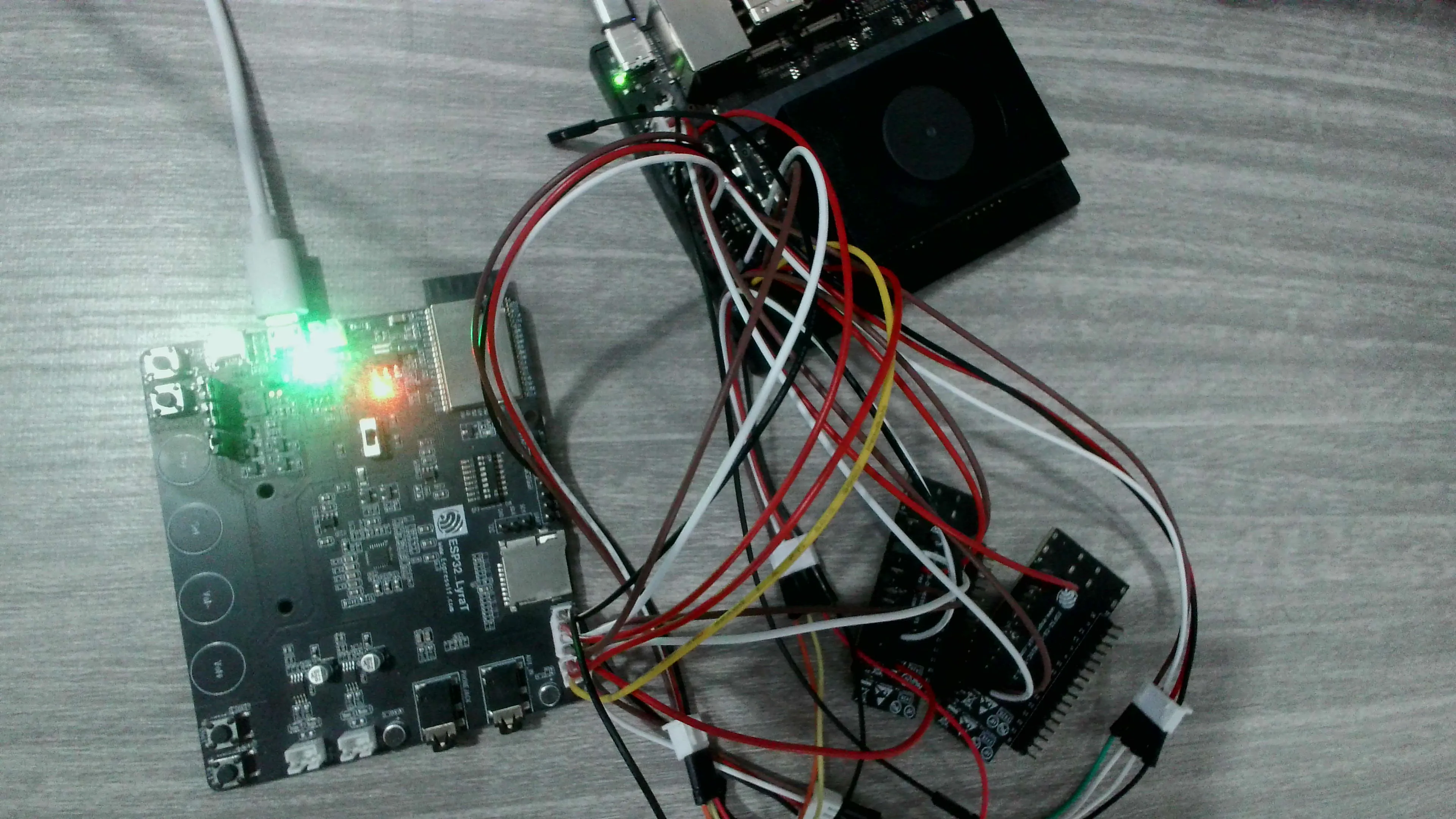
- Validated hardware wiring: Jetson J12 ↔ ESP32-C6
- SPI protocol: full-duplex, 1600-byte frames
- What’s working now: Wi-Fi and BLE
- The ESP32-C6: one chip for the whole home stack
- 67 TOPS + Thread = intelligent border router
- Current state and what’s next
Why the smart home needs a border router with a brain
Today’s “smart home” connectivity is a mess of silos. A Zigbee coordinator is one USB stick. A Thread border router is another device (usually a HomePod or a Google Nest). Your Wi-Fi AP is a third box. Matter is supposed to unify them, but the border router — the thing that bridges Thread devices to IP — is still a dumb pass-through. It forwards packets; it doesn’t understand them.
The vision for GeniePod Home is different: the border router and the AI agent run on the same hardware. When a door sensor fires a Thread message, the same board that routes it to your IP network can also run the inference that decides what to do about it. No cloud hop, no hub-to-hub latency, no third-party privacy exposure. The routing and the reasoning are co-resident.
That requires the Jetson to own all the wireless radios — and that means getting the ESP32-C6 kernel driver working on Jetson Linux.
ESP-Hosted-NG: turning an ESP32 into a Wi-Fi/BT co-processor
Espressif’s esp-hosted project is the standard way to add wireless capability to any Linux SBC using an ESP32 as a co-processor. The esp-hosted-ng (Next-Gen) variant exposes a native cfg80211/mac80211 Wi-Fi interface and a standard BlueZ HCI device — the host Linux kernel sees a normal wlan0 and hci0, with no knowledge that they’re backed by SPI transactions to an ESP chip.
The upstream driver was written and tested on Raspberry Pi. The GPIO numbers, the SPI bus enumeration, and the device-tree assumptions are all RPi-specific. Running it on Jetson meant porting every one of those assumptions.
The result is jetson-esp-hosted — a fork of ESP-Hosted-NG with a Jetson-native build script, a porting guide, and a validated hardware bring-up document for the Orin Nano.
The driver port: what actually changed
The kernel module esp32_spi.ko builds from the esp_hosted_ng/host/ tree as a standard out-of-tree ARM64 module — no cross-compilation, built natively on the Jetson in a few minutes.
The core changes vs. upstream:
1. All hardware identifiers are now module parameters. The upstream code hardcoded Raspberry Pi GPIO numbers throughout. Every GPIO (handshake, data-ready, reset), every SPI bus/CS number, and the clock speed are now module_param entries:
resetpin=-1              # host-driven reset disabled (safe default on devkit)
spi_handshake_gpio=471   # Jetson GPIO for ESP handshake signal
spi_dataready_gpio=433   # Jetson GPIO for ESP data-ready signal
spi_bus_num=0
spi_chip_select=0
spi_mode=2               # CPOL=1, CPHA=0
clockspeed=10            # MHz — clamped from ESP's requested 26 MHz
2. Clock speed cap. The ESP32-C6 requests a 26 MHz SPI clock at boot. The upstream driver honored that. At 26 MHz the Jetson SPI was unstable; the port added a spi_clk_cap_mhz field to the SPI context struct so clockspeed=10 hard-caps any runtime reconfigure request. The dmesg confirms the clamp:
Chipset=ESP32-C6 ID=0d detected over SPI
ESP requested SPI CLK 26 MHz, clamping to host limit 10 MHz
3. Device-tree coexistence. The Jetson’s SPI bus already has a spidev driver bound at boot. The init script unbinds it cleanly before loading esp32_spi.ko, and the driver itself locates the existing spi0.0 device in the tree rather than trying to create a new one.
4. Reset pin disabled by default. The devkit’s ESP reset line conflicts with the USB flashing path. resetpin=-1 disables host-driven reset; after loading the module, you press the ESP’s physical RST button once to trigger the boot handshake.
Validated hardware wiring: Jetson J12 ↔ ESP32-C6
| Jetson J12 pin | Signal | ESP32-C6 |
|---|---|---|
| 19 (SPI0_MOSI) | MOSI | IO7 |
| 21 (SPI0_MISO) | MISO | IO2 |
| 23 (SPI0_SCK) | Clock | IO6 |
| 24 (SPI0_CS0) | Chip select | IO10 |
| 15 (GPIO12) | ESP Data Ready | IO4 |
| 22 (SPI1_MISO) | ESP Handshake | IO3 |
| 18 (SPI1_CS0) | Reset (optional) | EN |
One naming quirk: Jetson-IO labels the preset as SPI1, but the live Linux device node is spi0.0. The init script handles this — just verify spidev0.0 exists before loading the module.
SPI protocol: full-duplex, 1600-byte frames
Every SPI transaction exchanges exactly 1600 bytes in both directions simultaneously, regardless of payload size. The handshake protocol:
- ESP raises Handshake when ready for a transaction
- ESP raises Data Ready when it has data for the host
- Host initiates when Data Ready is high, or when it has data to send
- On completion: ESP pulls Handshake low; if TX was non-null, pulls Data Ready low
This means the host SPI driver is IRQ-driven, not polled — low CPU overhead for background radio traffic. At 10 MHz the practical ceiling for the ESP32-C6 SPI path is below the published benchmark figures (those were measured at higher clocks), but more than adequate for home-automation traffic.
What’s working now: Wi-Fi and BLE
With esp32_spi.ko loaded and the ESP reset:
[dmesg] Received ESP boot-up event
[dmesg] wlan0: ESP Wi-Fi interface ready
[dmesg] hci0: Bluetooth device addedwlan0— standard cfg80211 interface; connects to WPA2/WPA3 networks viawpa_supplicantor NetworkManager; PHY rates 1M–72.2 Mbps (MCS7-SGI).hci0— standard BlueZ HCI device, bus type SPI;bluetoothctl scan ondiscovers BLE peripherals. The ESP32-C6 supports BLE 5.3 (advertising extensions, long range, coded PHY) — the full feature set is available once BlueZ negotiates the HCI capabilities.
The ESP32-C6: one chip for the whole home stack
The reason ESP32-C6 is the right co-processor isn’t just Wi-Fi and BLE. It’s the only ESP chip with three wireless radios in one package: Wi-Fi 6 (802.11ax, 2.4 GHz), BLE 5.3, and an IEEE 802.15.4 radio — the same physical layer used by both Zigbee and Thread.
That last radio is what makes this more than a Wi-Fi adapter story. Thread is the IP-native mesh protocol that Matter runs over. Zigbee (ZHA/ZHA3.0) still runs the majority of deployed smart-home devices. Both live on IEEE 802.15.4. With the right firmware on the ESP32-C6, a single SPI connection brings the Jetson:
| Protocol | Standard | Status |
|---|---|---|
| Wi-Fi 6 (802.11ax) | IEEE 802.11ax | Working (via esp-hosted-ng) |
| BLE 5.0/5.3 | Bluetooth 5.3 | Working (BlueZ HCI over SPI) |
| Thread | IEEE 802.15.4 + OpenThread | Planned — ESP-IDF ot-cli firmware + wpantund on host |
| Zigbee (coordinator) | IEEE 802.15.4 + Zigbee 3.0 | Planned — separate ESP-IDF Zigbee firmware |
| Matter (controller) | Thread + IP transport | Planned — on top of Thread border router |
The esp-hosted driver handles the Wi-Fi + BLE path today. Thread and Zigbee require different ESP firmware (OpenThread CLI or Zigbee coordinator app) and a host-side daemon (wpantund or ot-br-posix for Thread, Zigbee2MQTT for Zigbee), but the physical transport — the SPI link and the esp32_spi.ko module — is the same foundation.
67 TOPS + Thread = intelligent border router
A conventional Thread border router (Apple HomePod mini, Google Nest Hub, Amazon Echo) does one thing: route packets between the Thread mesh (IEEE 802.15.4) and the home IP network (Wi-Fi/Ethernet). It’s stateless, dumb pass-through. It doesn’t know what those packets mean.
The Jetson Orin Nano Super 8 GB runs 67 TOPS of INT8 AI inference at 25 W. When the Thread border router and the AI agent are the same device, the routing layer and the reasoning layer can communicate at local memory bandwidth — microseconds, not network round-trips:
- A door sensor fires a Thread message → the border router receives it → the LLM running on the same board decides in context (“it’s 2 AM, the garage door just opened, there’s no calendar event — send an alert”)
- A Zigbee power meter reports high draw → the agent correlates it with the HVAC schedule and adjusts the thermostat, all without leaving the box
- A BLE beacon from a family member’s phone updates the presence model → the agent re-hydrates context for the next voice command
This is the product concept behind GeniePod Home: one board, all radios, all inference. The ESP32-C6 is what makes the radio half possible. The genie-claw agent and genie-ai-runtime are what make the inference half possible.
Current state and what’s next
The driver port is validated on Jetson Orin Nano Super 8 GB + ESP32-C6 over SPI. Wi-Fi and BLE are production-ready as a co-processor path. The remaining steps toward the full intelligent border router:
- JetPack 6.1 + IPv6 filesystem rebuild — Thread is IPv6-only. The default JetPack 6.0 rootfs ships without the IPv6 kernel modules and userspace tooling fully enabled; enabling Thread on the Jetson requires rebuilding the filesystem on JetPack 6.1 with IPv6 support compiled in and
ip6tables,radvd, and the NAT64 stack (taygaor kernel masquerade) available. This is a hard prerequisite —ot-br-posixwill fail to bring up the Thread interface without a working IPv6 network stack on the host. The genie-os build targets JetPack 6.1 for exactly this reason. - Thread border router — flash OpenThread
ot-clifirmware to the ESP32-C6, bring upot-br-posixon the Jetson, configure NAT64 + RA so Thread nodes reach the IP network; expose a Thread commissioner API to genie-claw’s home control tools. - Zigbee coordinator — separate ESP32-C6 firmware image + Zigbee2MQTT on the Jetson; Zigbee devices appear as Home Assistant entities the agent can address.
- Matter controller — on top of the Thread border router, with CHIP SDK running locally; the agent calls Matter APIs for device commissioning and control.
- Production DT overlay — replace the
spidevunbind-at-boot workaround with a permanent device-tree overlay that reserves the SPI bus foresp32_spi.kofrom first boot. - SDIO path — higher throughput than SPI (22+ Mbps vs. ~16 Mbps for C6 over SPI); requires additional Jetson carrier board work in genie-hardware.
The kernel driver port is the foundation. Everything above it — Thread, Zigbee, Matter, the AI agent layer — is software that runs on hardware that now works.